SOS.CITY
Emergency card
This page works with no internet. Print it, save it, or send the file to people near you by AirDrop, Nearby Share or Bluetooth: it needs no signal to open.
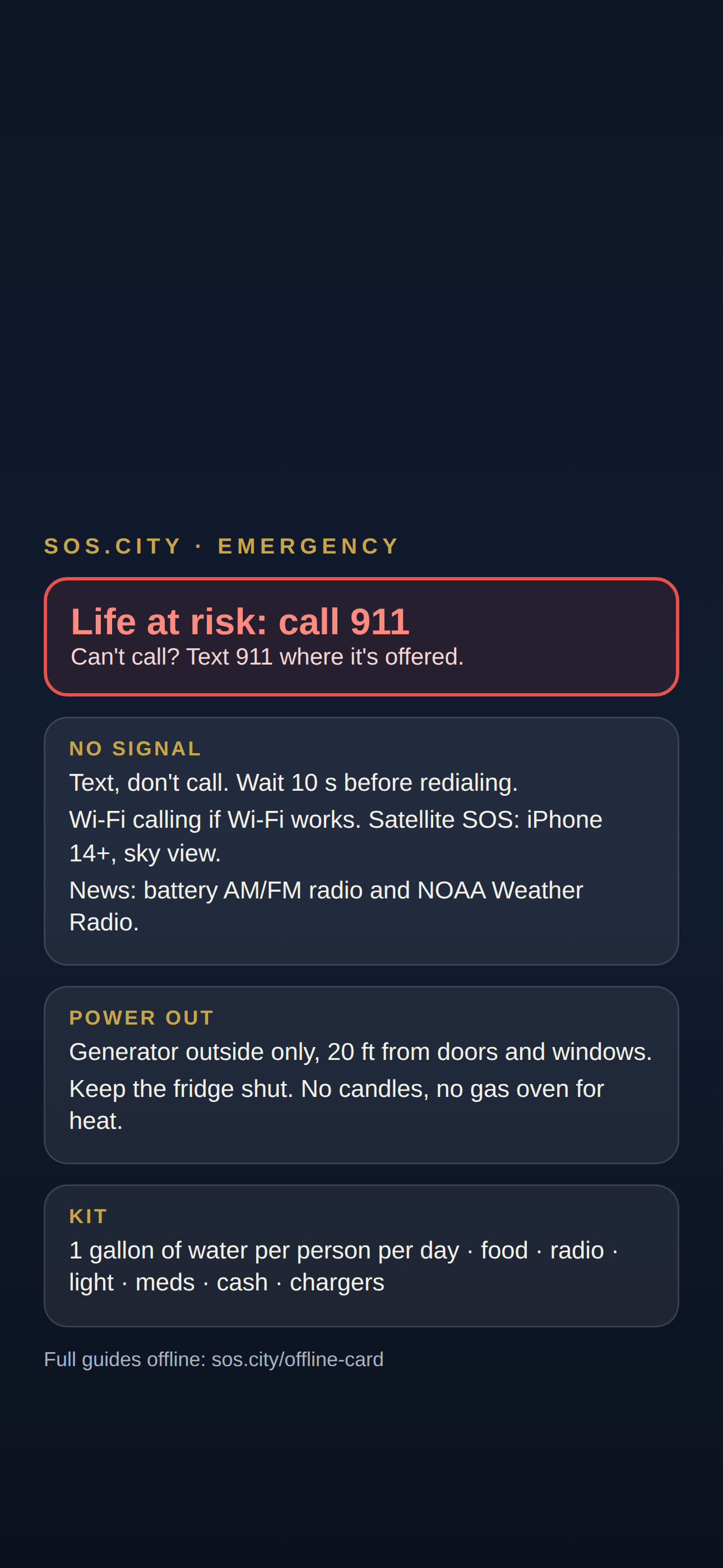
If a life is at risk, call 911. Text-to-911 works in many areas but not all: call if you can, text if you can't. SOS.city is a library of public information, not an emergency service.
Reach people when phones or internet are down
- Text, don't call. Texts often get through when calls can't. Keep calls short.
- If a call fails, wait 10 seconds before redialing. Fast redialing clogs the network.
- Cell down but Wi-Fi working: turn on Wi-Fi calling, use messaging apps and email.
- Home internet down but cell working: use your phone's hotspot.
- Satellite texting: iPhone 14 and later (Emergency SOS via satellite) and some carriers. You need a clear view of the sky.
- Radio for news: battery or hand-crank AM/FM radio and NOAA Weather Radio.
- Walkie-talkies: FRS needs no licence (about 1 to 2 miles). GMRS needs an FCC licence ($35, no exam, 10 years, covers your family).
- Post one short "I'm safe" message instead of many calls. Text one out-of-town contact who passes news on.
- Look for power and Wi-Fi at libraries, community centres and cooling or warming centres.
- Save battery: low power mode, dim screen, no video streaming, airplane mode between checks.
When the power goes out
- Use flashlights, not candles. Unplug sensitive electronics; leave one light on so you know when power is back.
- Keep the fridge and freezer shut. A closed fridge stays cold about 4 hours; a full freezer about 48 hours, a half-full one about 24.
- Throw out perishable food that has been above 40°F for 2 hours or more.
- Generators outside only, at least 20 feet from doors, windows and vents. Never in a garage, even with the door open.
- Never heat your home with a gas stove or oven. Have a battery carbon monoxide alarm.
- Check on neighbours who are older, ill or alone. If someone relies on powered medical equipment, move them to power early.
Emergency kit
- Water: one gallon per person per day, for several days
- Food: at least a several-day supply of non-perishable food, and a manual can opener
- Battery or hand-crank radio, and a NOAA Weather Radio with tone alert
- Flashlight, extra batteries, phone chargers and a backup battery
- First aid kit, prescription medicines and glasses
- Whistle; dust mask, plastic sheeting and duct tape
- Moist towelettes, garbage bags and ties; wrench or pliers for utilities
- Paper maps, cash, copies of documents in a waterproof bag
- Pet food and water; supplies for babies and anyone with extra needs
Fill in and keep
- Out-of-town contact:
- Where we meet:
- Radio channel we use:
- Utility outage line:
- Doctor / pharmacy:
Keep this with no signal
Sources: FCC and FEMA tips for communicating in an emergency; Ready.gov basic disaster supplies kit; CDC and USDA food safety and carbon monoxide guidance; FCC rules for FRS and GMRS radios (47 CFR Part 95).